I have truly been contemplating this post for two years.
That is how important this topic is to me.
I want to be factual. I want to be honest and vulnerable. I want you to hear the message so clearly that it rings in your ears for years to come.
Here we go.
Here is the photo that originally had me thinking about this:
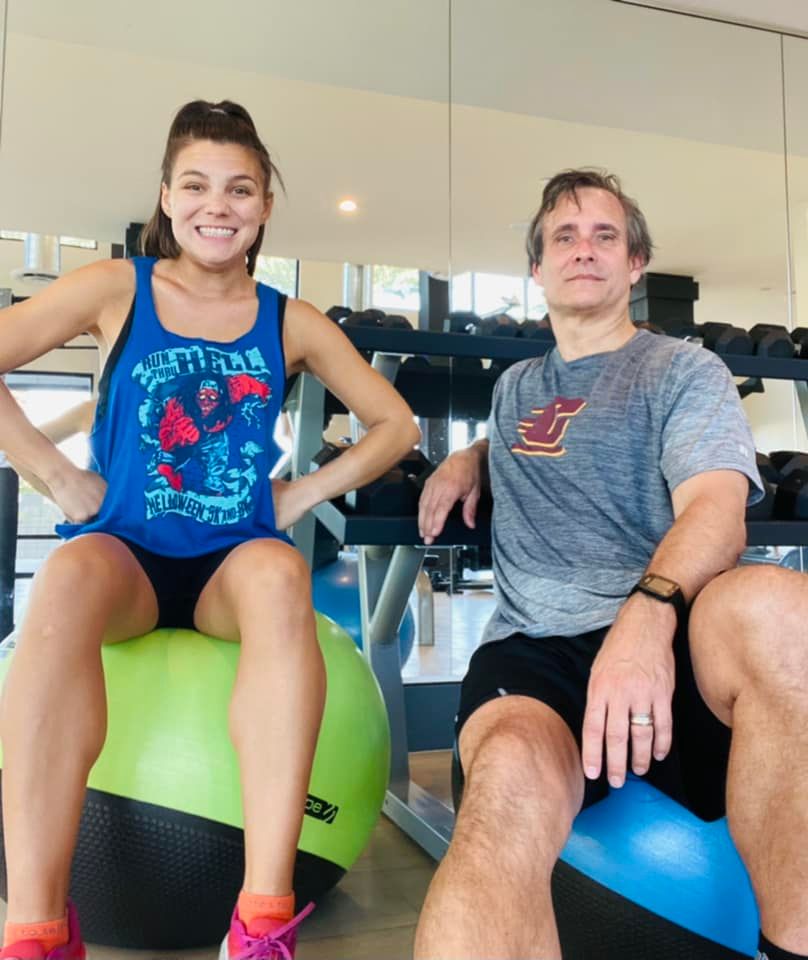
I didn’t save this photo when my Dad posted it because I thought this was perhaps the sickest I’d looked. I didn’t fully recognize myself, which made me terribly sad. I thought “Oh, this is what cancer looks like on me”. But do you want to know what made me not only sad but rather angry about this snapshot in time? I am within the “normal” body mass index (BMI) range in this photo. In fact, depending on if I was having a 5’3″ or a 5’4″ kind of day, I could have lost another 10-20 pounds, and I still wouldn’t have reached the “underweight” range.
Let me provide a little more context in case you are new here:
I had tongue cancer. I had some of my tongue removed. I needed a feeding tube while in the hospital post-surgery, but could not tolerate tube feeds. They made me puke. I then went home and ate broth or sipped a smoothie every day for the next 4 months, which I often could not keep down due to nausea related to chemotherapy. I was hospitalized again at the end of treatment because I wasn’t able to swallow water or liquid pain medicine due to the pain, and I gradually had to crawl my way back to sipping protein shakes. Not to mention, the few months before my diagnosis, I was under-eating due to pain.
Then, my BMI at the time that photo was taken, had the audacity to call me “normal.” Not only that, I could be much lighter, and it still would have been A-OK with Mr. BMI.
Narrator: She was not normal.
I was so sick, you guys. I was so so sick. I hadn’t eaten normally for nearly seven months at that point. I felt weak. Some days I couldn’t stand up straight, pain kept me up at night, and yet there I was, being categorized as “healthy” (which is what you’ll sometimes see the “normal” BMI range labeled as).
I was not meant to be 127 pounds. 127 pounds was my body’s hell and back.
My point: being thin is not healthy for everyone.
The exact weight I was is not what is important. I point it out here only because the imaginary weight I always had in my mind – the weight I thought I should be – was 125 pounds. A different type of weight was lifted off my shoulders the day I realized how silly and unrealistic that was.
That is because we have what is called a set point weight. Which is a weight plus or minus 5 to 10 pounds that we naturally hover at due to a genetic predisposition and our body’s desire to remain in homeostasis. This is the weight you are at in the absence of illness, caloric restriction, and extreme exercise, and the presence of good sleep, a nourishing relationship with food, and mindful regular movement.
This means some of you reading this may just be your most authentic self when your body’s relative mass is around 127 pounds. Beautiful.
I was not. I was so clearly not my most authentic healthy self.
Now, before I go any further, I want to make sure I didn’t lose anybody who thinks “Well, if you lost weight the right way you wouldn’t have felt so bad.”
And I’m here to tell you, I’ve done that too.
I’ve reached 127 pounds the “right” way. The counting macros (macronutrients: protein, fat, and carbohydrates), regular exercise, fun cardio, one-cheat-meal-a-week sort of way. Guess what? I was self-conscious then too. Even more so, because I knew how much work I was putting in to be there, and I didn’t want anyone to know it wasn’t the real me. It was the me that thought about food nearly non-stop, the me that weighed myself to determine my mood, and the me that knew I couldn’t keep it up forever. And I didn’t. It was unsustainable.
Because I wasn’t meant to be 20 pounds below my set point weight and neither are you.
Yet here we are. Wanting to be the thinnest version of ourselves.
And we all know why. Because we’re fat-phobic, because cool movie stars are thin, because models, whom we deem are the prettiest among us, are thin, because people who post inspirational exercise videos are often thin, because our clothes feel better when we’re thinner, because we get more compliments when we’re thinner, because because because we all know the because, but I’m here to scream from the rooftops that all of that may be true, but thin is still not synonymous with health.
Our fat phobia is steering us away from being our most authentic healthiest selves.
In the book “Your Weight is not the Problem” by Lyndi Cohen, she sites studies that observed individuals who are categorized as “obese” by the BMI, and here’s some of what they found: older individuals and those with chronic conditions fare better than those that are thin (Donini, Pinto, et al., 2020). They have a lower mortality rate and appear to be assisted in recovery by their stored energy sources. In addition, cancer patients categorized as “obese” were observed to have “smaller tumor size, less aggressive forms of cancers, and less progressed stages of the disease” (Trestini, Carbognin, et al., 2018). She continues with that same theme much longer, and I strongly recommend the book to anyone.
Simplifying your health into height and weight is completely missing the mark. Furthermore, the weight you may so desperately be trying to lose may be the same weight your body puts exactly where it is to keep you safe. Fat of all kinds, for instance, serves many essential functions in the body (which is beyond the scope of this blog post), but every kind your body has, it has for a reason!
Maybe you already knew this. Maybe you’re well aware the BMI chart was invented by a statistician in the 1800s who studied the average size of white men in Europe and the only part you’re confused about is how it then got translated into a critical piece of information for your insurance company to know. Me too.
But, maybe you’re also wondering, if we toss out weight and the entire BMI chart, what’s left? What tells me that I am my most authentic healthiest self?
I’m so glad you asked 🙂
TONS OF THINGS
That Lyndi also chats about in her lovely book…things like:
- comfort
- mindfulness
- energy levels
- peacefulness
- feeling strong
- blood pressure
- resting heart rate
- blood test results
- feeling well rested
- ease of bowel movements
- meeting personal exercise goals
That list could go on and on and on, and not once would I mention how much you weigh.
Here’s the bottom line: thinness is not health for everyone. What you weigh is likely you as your most authentic self if you are sleeping well, nourishing well, and moving well (within your abilities). Attempts to be inauthentic will be exhausting, and, in my opinion, a waste of this beautiful short little life.
Please do yourself a favor this resolution season and set any other goal besides weight loss. (Even if it’s what your Doctor is recommending! If weight loss is what your body needs, it will happen when you are taking care of all the other things!) Please honor your authentic self. Please know that the societal pressures to be your inauthentic self are real, and take it from a recovering dieter and cancer patient, it’s not all it’s cracked up to be.
The hard truth: now that I am back at my set weight (~150 pounds) I struggle to love what I see in the mirror every day, I struggle to feel as cute in the clothes that I loved when I was thinner, and I struggle with wanting my thoughts to be more positive than they tend to be. What I don’t struggle with is reminding myself that I am being true to myself. That I eat in a way that honors myself and the energy I want to have each day, that my sleep habits make me feel bright-eyed and bushy-tailed, that I take my medicine on time because I’m more me when I’m not in pain, that when I exercise I feel confident, not defeated, that when I walk my dog I feel connected to him and nature and that when I am with the people I love, they are seeing the most real me I’ve ever been, and so I know, deep in my soul, the love I receive from them is the most authentic it can be. And that is worth more than its weight in anything.
Getting to a place where I feel I can talk about these topics intelligently and honestly is thanks to those who earned their degrees in food and then so generously shared what they learned:
Favorite Follows: no.food.rules, feelgooddietitian, foodsciencebabe, nude_nutritionist
Favorite Listens: The No Food Rules Podcast, plus New York Times’ Suggestions
Favorite Reads: Intuitive Eating, Your Weight is Not the Problem
A special thanks to my friend, Kylie, who is a Registered Dietitian, and was kind enough to check this post for any logical fallacies before I shared it with you all 💙


 a small hope
Leave a reply to Ruth Allen Cancel reply